
Process Transparency
Operations on Finarium leave a paper trail — not because we're asked for one, but because it's built into how the platform works.
Documented at every stage
Transparency is a core Finarium principle: every operation can be traced and confirmed with documents.
That's not a policy statement — it's a document your team can actually download, at whichever stage of a transaction they need it.
Most platforms can tell you a transfer happened. Finarium can show you: when it was created, which wallet or account it moved through, and when it completed — each as a standalone document, generated automatically.
Payment confirmations, at every status
Fiat and stablecoinFrom the moment a payment is created, through approval, to final execution, each stage produces its own confirmation — with a transaction ID, timestamp, payer and counterparty details, wallet addresses, and status, whether the payment is in fiat or in a stablecoin like USDC.
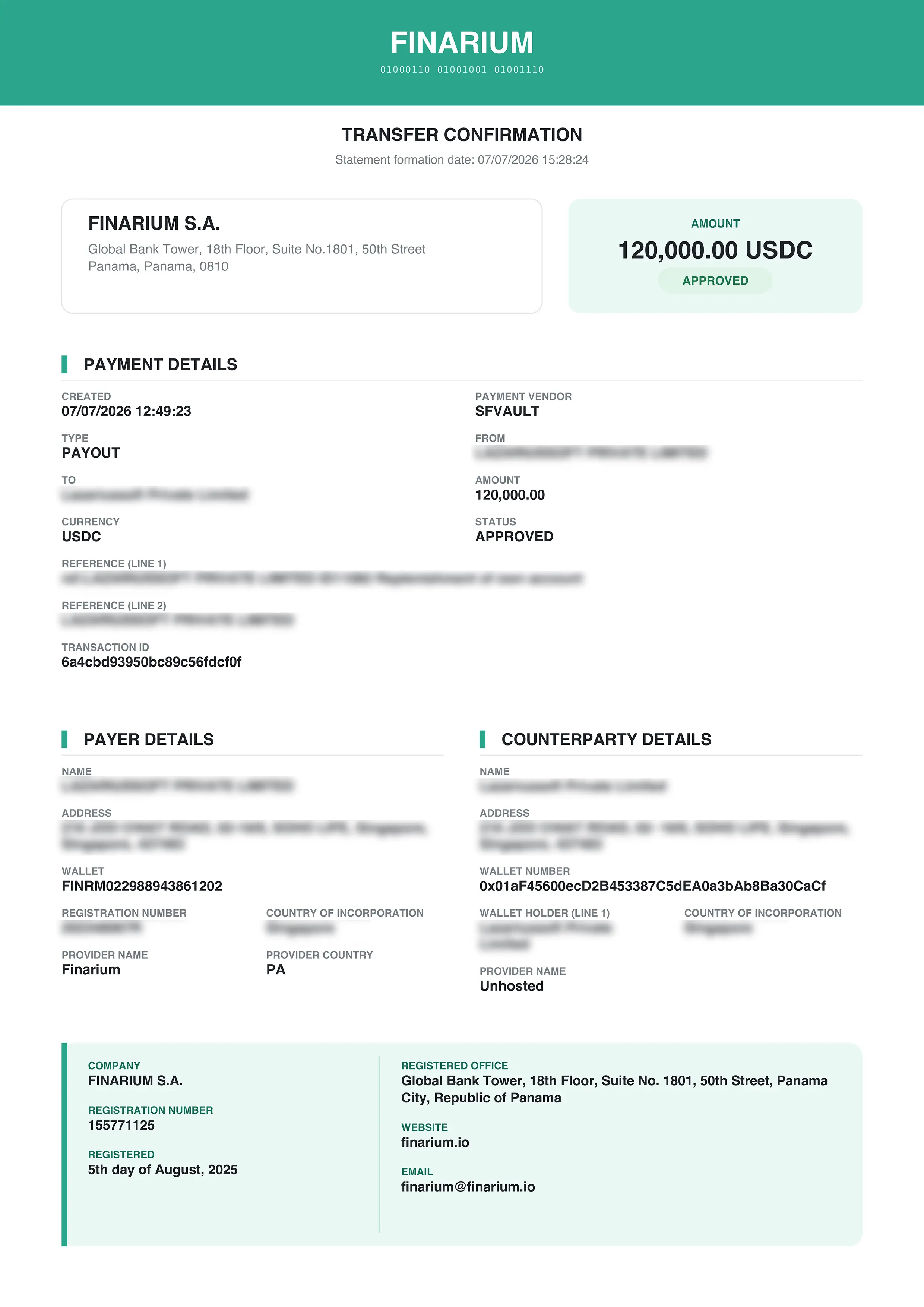
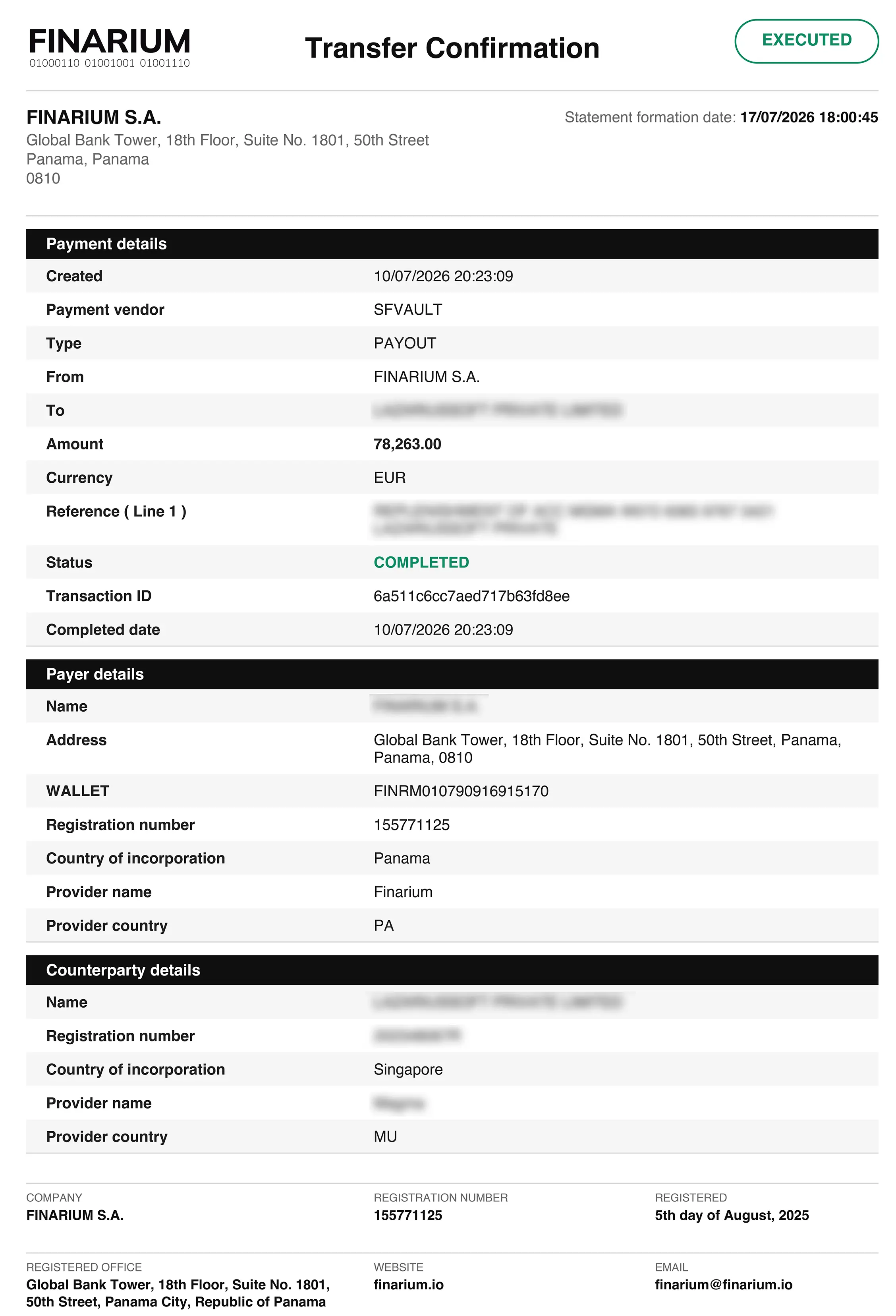
Account statements, fully itemized
StatementsBeyond individual transactions, clients can download full account statements for any period — opening and closing balances, turnover, and a line-by-line breakdown of every movement in and out, across each currency held.
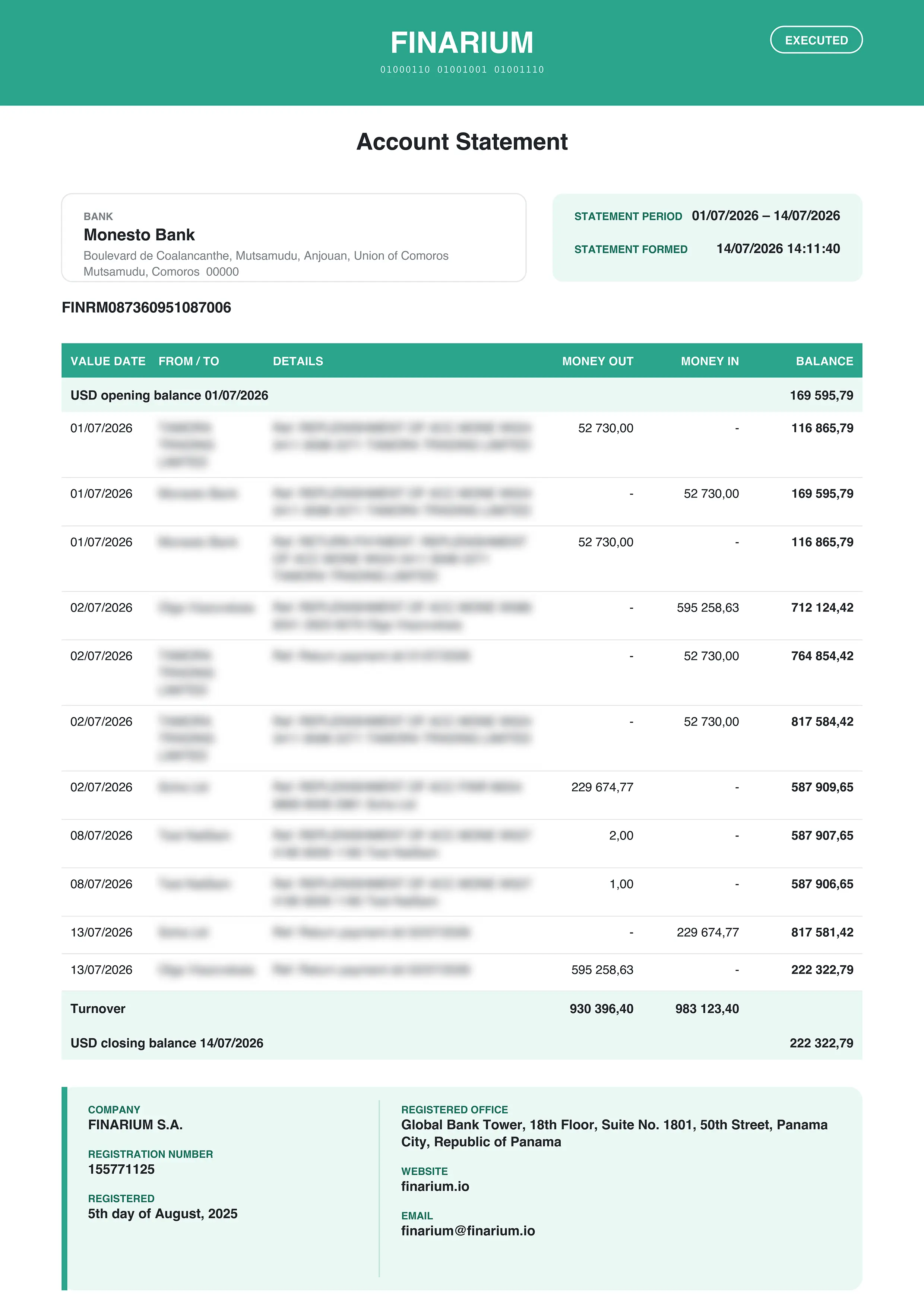 03 · Account statement · period
Available to whoever needs them
On requestReports and statements are available at the request of the client, a partner bank, or a regulator — the same documents, whoever is asking.
How we build transparency
Four foundationsVerifiable transaction path
Every operation is traceable from fiat confirmation through to crediting the recipient — not reconstructed after the fact, but recorded as it happens.
Segregated storage
Client assets are held separately from the company's own funds, at every stage — visible in the structure of the statement itself, not just claimed in a policy document.
Travel Rule compliance
Sender and recipient information travels with every transaction, in line with FATF's Travel Rule — the same data that appears on the confirmations you can download.
Regulatory reporting
Reporting is built for regulatory scrutiny across 12+ jurisdictions, aligned with FATF standards and structured to support CASP licensing requirements — generated automatically, not assembled by hand when a request comes in.